Investors
A plain guide to how property development works for investors in London, from finding a site and getting planning to building, selling and sharing returns.
Lukasz Kisiel MCIOB, Chartered Construction Professional

16 November 2026
Property development in London and the Home Counties follows a defined sequence: site identification, option agreement or acquisition, planning application, finance structuring, construction, and sales or refinancing. Kisiel Group manages all stages in-house, from land sourcing through to completion. We work on projects ranging from a single home up to schemes of around 100 homes.
The development process follows a structured sequence from site identification through to completion and exit. Property development and property investment are two different activities that often get blurred into one. Development creates new assets. Investment holds existing ones for income or growth.
Investing in development combines both. Development adds value through planning, construction and repositioning. At Kisiel Group we handle these stages under one roof.
The process breaks into clear phases. Each needs specific expertise and capital.
Kisiel Group is an award-winning property developer and main contractor working across London and the Home Counties, trading since 2007. Our work spans ground-up new build, airspace developments and conversions (change of use).
Sourcing and appraising a site needs a structured, evidence-led process. It starts with site identification and a feasibility study that tests every assumption before capital is committed. A site that fails on planning policy, access or ground conditions erodes margin from day one.
The best deals are usually off market. They never reach an agent's website or an auction catalogue, so there is less competition and more room to agree sensible terms with the owner. Once a site is openly marketed, the price is set by whoever bids highest, and the margin often goes with it.
We are unusually well placed to find these sites. Since 2007 we have built direct relationships with landowners, agents and public bodies such as TfL. And because we are developer and builder in one, we can move quickly, take on planning risk and give a landowner real confidence that the scheme will be delivered. That is why owners often come to us before they go to market.
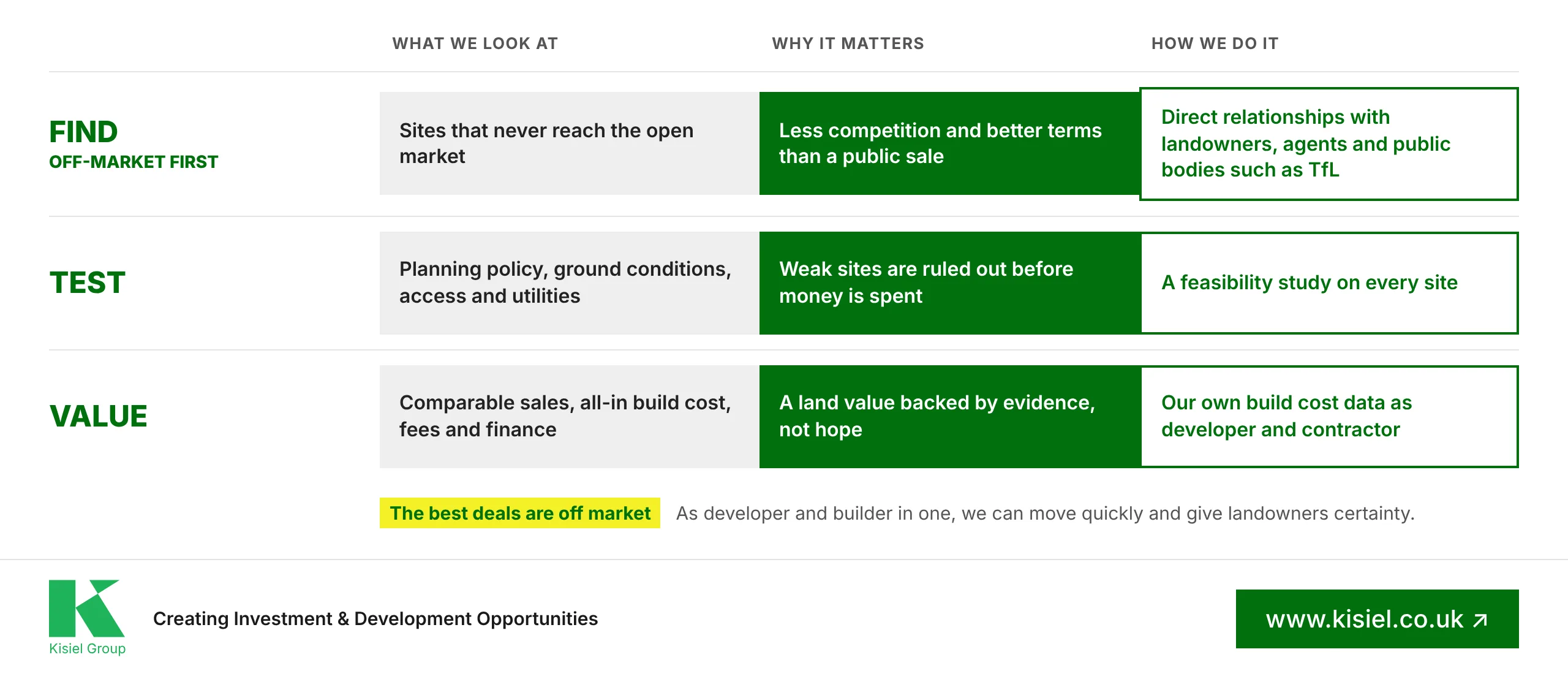
Once we have a site, we check its suitability against planning policy, environmental constraints and utility access. This rules out unsuitable plots before design work begins.
We work across three development types: ground-up new build, airspace developments, and conversions through change of use. Each needs a different appraisal. At West Wimbledon we turned one house into three executive town houses, now completed. Our North London scheme of around 70 apartments needed a very different viability model.
Appraisal starts with the residual land value. We work backwards from the projected GDV, taking off build costs, professional fees, finance costs and the required profit. What is left is what the site is worth.
We also work with landowners: for example, three airspace developments in Bromley for one landowner, 16 apartments in total.
There are three main ways to work with us. Each suits a different capital position and appetite for risk.
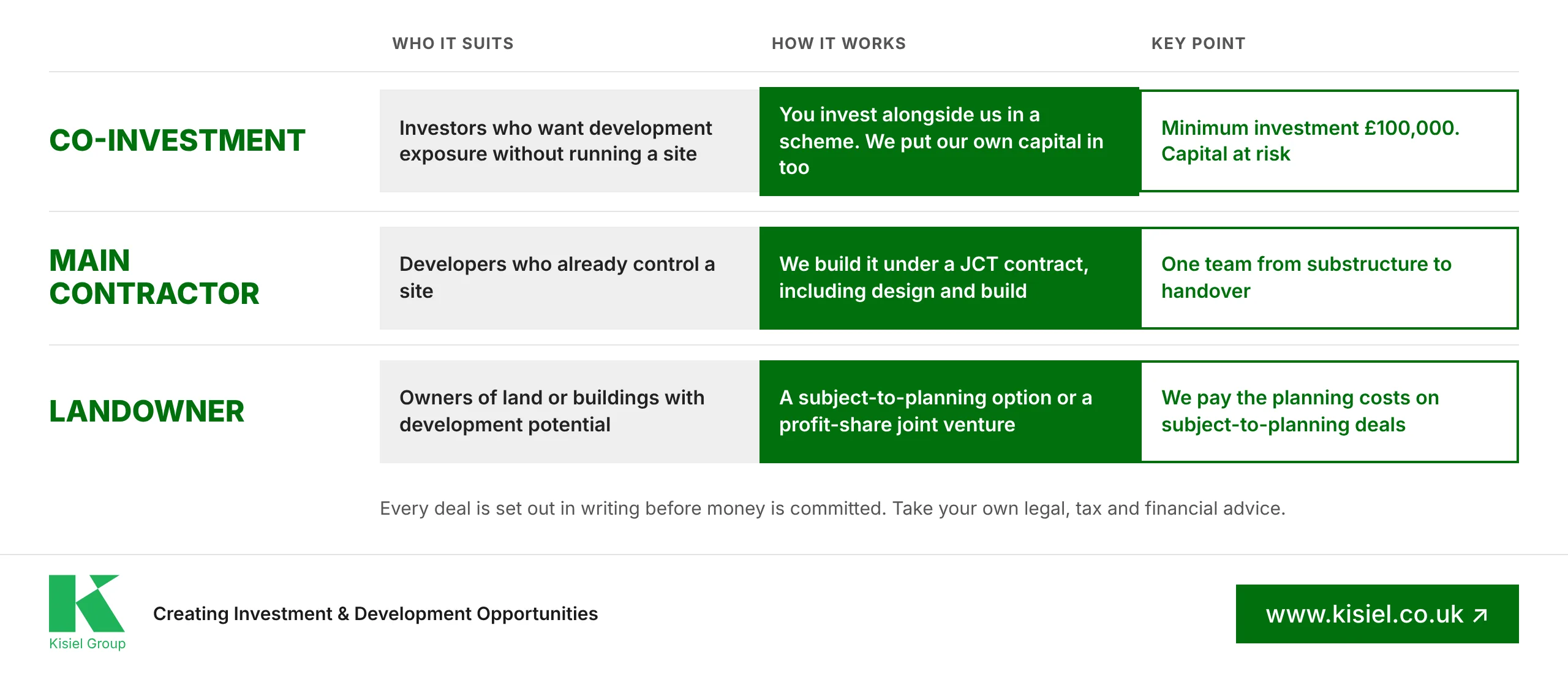
We are developer and builder in one. Our structures fall into three categories:
A joint venture pairs a landowner’s site with a developer’s capital and delivery capability. The landowner contributes the land. We contribute planning expertise, construction and funding. Profit is shared on the agreed terms.
Our joint venture options for landowners follow two paths. A subject-to-planning option defers the purchase until planning consent exists. A profit share keeps the landowner in the scheme through completion, sharing in the outcome rather than taking a fixed price.
Investors who want development exposure without day-to-day involvement fit the co-investment model. We find sites, secure planning and build with our own team.
Developers who already hold land or planning consent are better suited to the main contractor route. JCT contracts, including design and build, set out delivery obligations while the developer keeps ownership of the scheme.
A planning application needs a fully developed concept before submission: development type, design, size and budget. Without this, applications stall. Delays add holding costs and push returns further out.
A detailed project plan covering timelines, budgets, resources, risks and deliverables. Every element must fit the borough’s local plan. Gaps can lead to refusal, and resubmission adds months.
For investors, the planning stage is where capital is most exposed. We take a sequenced approach:
We also work in partnership with Transport for London under the GLA Small Sites programme. Our work has been recognised with the FMB London House Builder Award in 2021 and 2025.
Construction turns approved plans into finished homes through a phased sequence: site set-up, substructure, superstructure and finishing. Each stage has building control sign-offs and programme milestones. Delays at any handover point squeeze the later trades and the development margin.
We use Modern Methods of Construction, including structural insulated panels (SIPs), light gauge steel framing and modular systems, using BOPAS-accredited systems. These approaches move work from site into factory-controlled conditions and reduce wet trades.
Piling is delivered by our own in-house piling team. Keeping piling in the group gives us direct control over the foundation programme, which matters on tight urban sites where access limits rig size and headroom.
Our work includes three airspace developments in Bromley for one landowner, 16 apartments in total, and Sandiford Studios in Sutton, where we converted an office and warehouse building into creative workspace.
For developers bringing forward their own sites, our main contractor service gives a single point of responsibility from substructure to handover.
Marketing starts before completion. Plan the exit early. Price on local comparable evidence. Use selling agents who know the local market. Keep holding costs down, because every month of unsold stock eats into profit.
Each deal sets out its terms in a written agreement before money is committed. A common order is return of capital first, then any agreed priority return, then a profit split. The split and terms differ by deal. Returns are not guaranteed. Development carries risk and capital is at risk.
Investors co-invest alongside us, and we put our own capital in. When the developer has its own money in the scheme, both sides have a reason to protect it. A landowner can also take part through a profit share, exchanging land value for a share of the development profit rather than a fixed price. Our guide to co-investing in property development explains the capital stack in more detail.
Investors co-invest alongside us, and we put our own capital in, across ground-up new build, airspace developments and conversions in London and the Home Counties. The minimum investment is £100,000, for high net worth and sophisticated investors only. Find out more about investing with Kisiel Group, or register your interest and we will be in touch about upcoming opportunities.
Capital is at risk. Property development investments are illiquid and returns are not guaranteed. This article is general information, not financial advice.
Tell us about it. You will speak to the people who make the decisions.