Landowners
How a joint venture with a developer-builder works for landowners in London and the Home Counties: the two structures, the six stages, and the mistakes to avoid.
Lukasz Kisiel MCIOB, Chartered Construction Professional
3 November 2026
A joint venture pools land, capital and delivery expertise into a single scheme. We see the landowner contribute the site while we secure planning, fund and build the project. Profit is shared on pre-agreed terms, with the landowner receiving their share after all costs are repaid. We are a developer and builder working across London and the Home Counties, and we have been trading since 2007.
A joint venture in property development is a strategic collaboration where two or more parties pool resources such as capital, land or expertise to deliver a project none could manage alone. A property development joint venture means the parties put a site, money and a team into one scheme and share what it makes.
For landowners in London, this structure solves a practical problem. A site may have clear development value, but funding it, securing planning and managing build risk may be beyond one party’s reach. A JV spreads that load among partners with differing strengths.
Why landowners enter a joint venture with developer partners
Usually, a partner brings something the other side needs, such as access to finance, or experience on projects of a certain type or scale. In return, the partner gets a chance to make a profit. Both sides can build a longer-term relationship. The right JV partner creates a collaboration that benefits everyone.
We work with landowners on two structures: a subject-to-planning option, or a profit-share arrangement backed by our own capital. If you are weighing up a joint venture for your site, see how our joint venture partnerships work before you commit.
Joint venture agreements with property developers set out what each party contributes and how proceeds are shared. The agreement records the site, the funding and the delivery team in one document. Terms vary deal by deal, so no two structures match exactly.
Confirm what each party contributes before signing. Establish how profit is divided and who carries planning and build risk. Clarity at this stage protects your decision, because the agreement governs the outcome long after heads of terms are signed.
A landowner joint venture option in London combines each party’s assets: one side contributes the site, the other brings capital, development management, construction expertise or access to finance. We act as that second party. We take a London site through planning and build while the landowner retains an interest in the outcome. We work on ground-up new build, airspace developments and conversions (change of use).
The alternatives are rarely satisfactory. Selling too early leaves value on the table, while self-developing exposes you to planning risk, contractor risk and borrowing pressure. A JV is a middle ground. It also requires a level of day-to-day involvement many landowners don’t want.
We offer landowners two structures:

Both routes fall under joint venture agreements with property developers, and each is written to suit the site.
Land is the landowner’s contribution. We supply the capital, planning work and construction team. This division of roles is the core of any joint venture with developer arrangement.
We assess the site, agree the structure and secure planning. Construction follows with our own team. Landowners can begin with a subject-to-planning option and convert to a profit share if the scheme merits it.
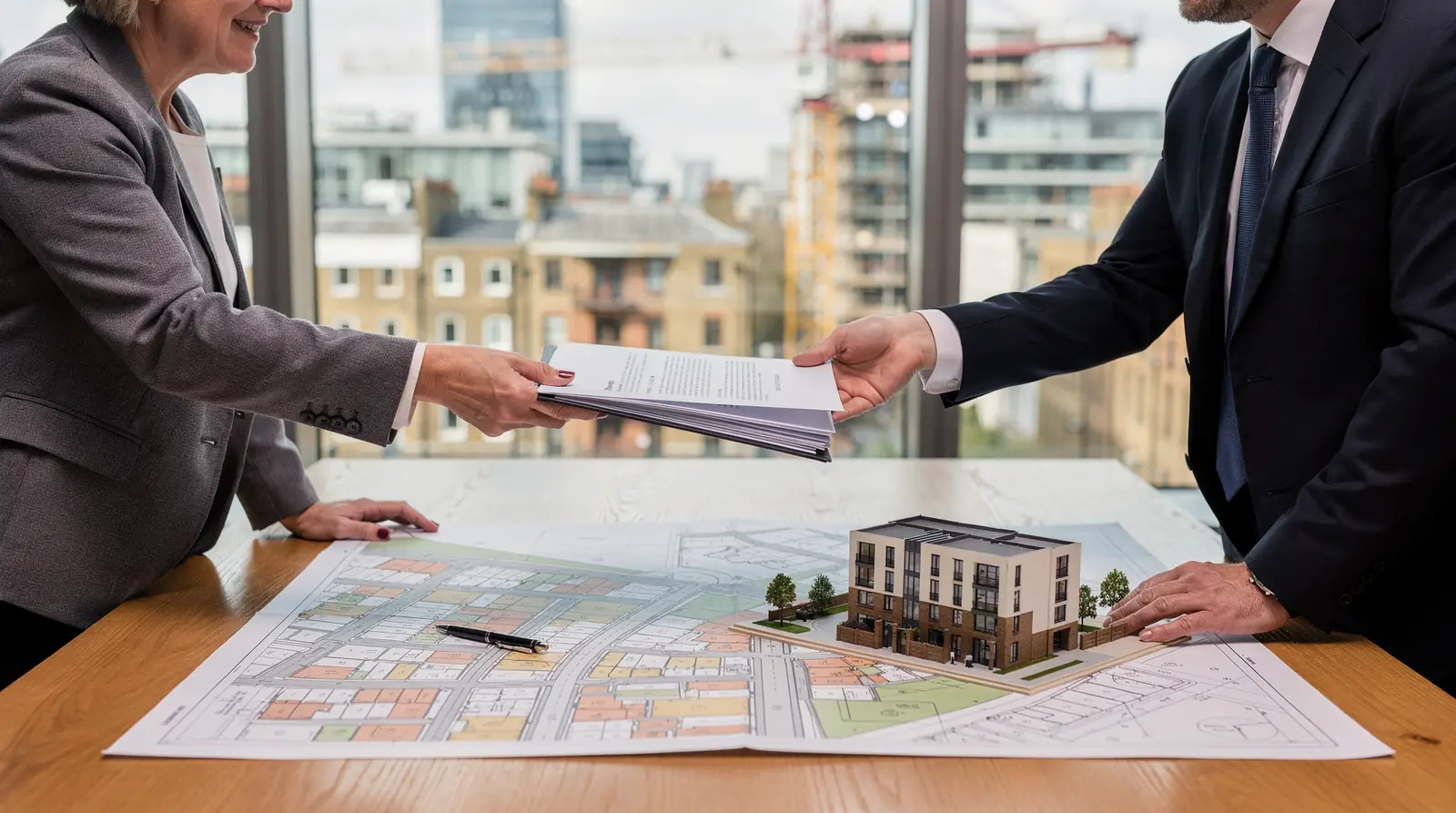
A joint venture with a developer moves through six defined stages. Without a clear stage-by-stage framework, expectations drift and risk builds quietly. A written agreement structures the entire journey around these: site, vehicle and agreement, funding, planning, build, and exit.
The site stage determines whether the land suits a joint venture with developer arrangement. We assess planning potential, access constraints and market demand across London. Not every plot works. We reject sites where the numbers do not stack up, saving both parties wasted time and cost.
Joint venture agreements with property developers formalise the partnership through a dedicated vehicle. This creates the legal container for the project. Each party is paid back in a written order, and profits are shared according to terms agreed deal by deal. The landowner keeps the upside but waits for it, so the agreement is written for the bad day. Funding blends senior debt, equity, and sometimes the land value itself as contribution.
Planning and build stages then execute the consented scheme. We act as developer and builder in one: we find sites, secure planning and build them with our own team, with piling carried out by our sister company Kisiel Piling. Exit completes the cycle through sale or refinance, returning capital and distributing profit in the agreed order.
We work this way across London and the Home Counties. In Bromley, for example, we are delivering three airspace developments for one landowner, totalling 16 apartments. We also have a development partnership with TfL under the GLA Small Sites programme.
Yes. We put our own capital into the schemes we build, so our interests line up with yours. Our guide to deal structures for selling land to a developer explains when each route suits a site.
We structure joint venture agreements with property developers around a written order of payments and a fixed profit formula before work starts. The agreement records who contributes land, capital and delivery, then sets how each party is repaid and how the remaining profit is divided. A partner who promises a return is selling, not partnering; no partner can guarantee an outcome.
We see joint venture agreements as a sequence of decisions, not a single document. The steps are:
We do. We are developer and builder in one. Our own team builds the scheme, and piling is carried out by our sister company, Kisiel Piling. Where it suits the site, we use modern methods such as SIPs, light gauge steel and modular, using BOPAS-accredited systems. One team carries the scheme from planning to completion, so nothing falls between the agreement and the build.
The most damaging mistake is treating a joint venture as a shortcut past the hard parts. Funding, planning, design, consent, build and sale all still need doing. A partner does not remove that work. Landowners who misjudge this lose leverage before a single brick is laid.
Four mistakes come up again and again. Avoid them:
When you want more than a fixed land price but do not want to fund, plan and build the scheme yourself. Most landowners we speak to are in that position. If you want certainty, a subject-to-planning option or a straight sale may suit you better. We can talk you through both.
Set the exit before the entry. Define who funds what, who carries planning risk, and how proceeds split. Then hold the partner to delivery evidence. Landowners who agree clear terms keep the upside. Vague terms surrender it.
A joint venture pools land, capital and delivery expertise into one scheme. The landowner contributes the site while Kisiel Group secures planning, funds and builds, with profit shared on pre-agreed terms after costs are repaid.
Kisiel Group offers a subject-to-planning option, where a purchase price is agreed now and paid once planning is granted, or a profit-share joint venture, where the landowner shares development profit instead of selling at a fixed price.
Confirm what each party contributes, how profit is divided, and who carries planning and build risk. Clarity at this stage protects the decision, as the agreement governs the outcome long after heads of terms are signed.
A joint venture works when the terms are clear from day one and the partner can actually deliver. If you own land in London or the Home Counties and want to explore a joint venture, an option or a sale, see how we work with landowners or ask for a free site appraisal.
Tell us about it. You will speak to the people who make the decisions.